Woman caught bringing heroin to her prison pal


WOMAN pal of a man jailed over a €440m drugs seizure has been caught smuggling €6,000 of heroin into his prison. The middle-aged woman was caught by prison officers last week when she arrived at the Midlands Prison for a visit to Joe Daly (44). He is serving a 25-year sentence after being convicted of possessing the biggest cocaine haul in the State's history -- a seizure of 1.5 tonnes of cocaine at Dunlough Bay in 2007. Prison staff contacted gardai, who then arrested the woman. She was brought to Portlaoise Garda Station where she was questioned by detectives before being released without charge. A file is now being prepared for the DPP. Captured Sources say if the heroin had got into the jail, it would have had a value of "well over four times" the estimated street value that gardai put on the drug. The woman was not allowed to visit English national Daly after being caught with the drugs. Daly and three other English criminals are serving lengthy jail terms for their role in the plot to smuggle €440m worth of cocaine into Ireland in July 2007. Martin Wanden (48), police- killer Perry Wharrie (51), Gerard Hagan (27) and Daly were captured after diesel, instead of petrol, was put into the fuel tanks of their boat, which was carrying the drugs off the coast of Co Cork. When the vessel capsized, 62 bales of cocaine weighing over 1.5 tonnes were thrown into stormy seas, scuppering a huge drugs operation that had been months in the planning. Liverpool criminal Hagan admitted his role in the enterprise and was jailed for 10 years. However the other three men contested the charges but were convicted after a marathon 10-week trial at Cork Circuit Criminal Court which heard from 200 witnesses. Two of the defendants claimed in direct evidence that they were entirely the victims of circumstances, coincidence and bad luck. Joe Daly said he had only gone to west Cork as a favour for his brother, who had wanted a RIB delivered. But it would later emerge that Joe Daly's brother was Michael Daly (50) -- a former Metropolitan Police detective who is now serving combined sentences totalling 29 years in a UK prison in relation to the Co Cork plot and another cocaine importation plot. Gardai believe that Joe Daly became involved in the drugs smuggling operation through his older brother, Michael. Daly presented a defence that depicted him as very much under the influence of the brother. Children Born in London to Irish parents from west Cork, Daly worked as a bricklayer with his own business, JD Bricklaying, is married with three children and lived in Bexley, Kent. It emerged that he had a number of previous convictions in the UK for offences including threatening and abusive behaviour, assaults on police officers and possessing a blade. During the trial, his uncle, Tom Lydon, told how Daly visited him on the day before the drugs seizure and watched the Munster football final between Cork and Kerry on TV. He described him as very obliging -- "the first man to come around" if anyone needed help.

shut down drive-through drug operation near University Mall, expect more arrests


One by one, motorists arrived, rolling down windows and giving up cash, as they would at a fast-food restaurant. This drive-through opened at 11 a.m. some days, but lunch was never on the menu. Instead, customers could order cocaine, oxycodone, ecstasy and marijuana. Guns, too. At a news conference Wednesday, the Hillsborough County Sheriff's Office announced that it had broken up a drug trafficking ring that caught even investigators by surprise. About 11 months ago, deputies began building cases against two men reputed to be dealing drugs in a neighborhood near University Mall. Investigators thought Zavien Brand, 28, and Joseph Nurse, 35, might lead them to a few more people, maybe six or eight, said sheriff's Maj. J.R. Burton. But the small undercover probe soon turned into a larger investigation — dubbed Operation Pandora's Box — as deputies realized the area's loose-knit group of dealers included dozens of people. On Wednesday, sheriff's officials announced they had 54 warrants and, as of 4 p.m., 32 arrests, most on drug and gun possession charges. "We had no idea this was going on," Burton said. They focused on several addresses in the neighborhood near Nebraska and Fletcher avenues. The drive-through was at the Pines I Apartments at 11720 N 14th St., deputies said. Deputies took 29 guns off the street, including seven assault rifles and two weapons believed to be linked to shootings in the area. Also seized: about 1.3 pounds of crack cocaine, 0.64 ounces of powder cocaine, 0.25 ounces of oxycodone and some ecstasy — valued at about $75,000 total, Burton said. Burton hopes the operation sends a message to an area that has long struggled with crime, and he wants residents to know that deputies aren't done. Brand was charged with dealing crack cocaine and being a felon in possession of a gun. Nurse was charged with dealing crack cocaine, marijuana and stolen property. Deputies planned to continue executing search warrants until they arrest all 54 suspects.

DEA Bans Synthetic Cocaine Masked As Bath Salts


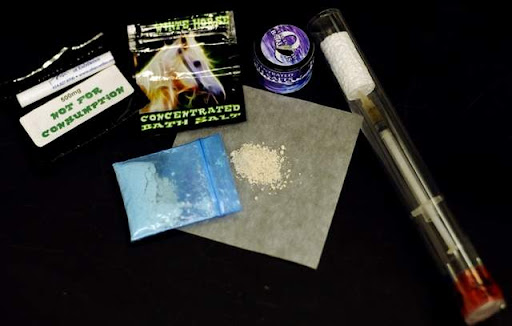
The U.S Drug Enforcement Agency's war on drugs continues with a nationwide ban of synthetic cocaine. Labeled as bath salts, the hallucinogenic drug has become more available in the Grand Junction area as part of a trend seen across the country. In response to increased emergency room visits, the federal agency has moved to emergency control these synthetic stimulants. This action makes it illegal to possess or sell Mephedrone, Methylenedioxypyrovalerone (MDPV), and Methylone or any products containing them for the next year. These chemicals are most often found in forms of 'legal ecstasy' or 'legal cocaine.' During the temporary ban, the DEA will team up with the U.S. Department of Health and Human Services to further study whether these chemicals should be permanently banned. In June, we introduced you to these bath salts in this article. Back then, they were an unregulated drug taking the place of recently banned synthetic forms of marijuana. "It is actually like a synthetic cocaine slash methamphetamine," Jim Schrant with the DEA told us at the time. "So, it's really the worst of both." The bath salts sell at a price of $40 per gram. They are mainly sold at smoke shops. But, in June, Schrant told us that his agency could not find any local dealers. Today, there are at least two. "They're putting it into packaging which is pleasing to the eye with market names of "Blue Dreams," things like that," Schrant said. "And, they're intentionally trying to target that young adult crowd." As part of this emergency control, businesses and citizens have 30 days to get rid of the banned products. At that time, the DEA will publish a Final Order in the Federal Register making the drugs Scheduled 1 substances. That category is the harshest and is reserved for unsafe, highly abused chemicals with no known medical use in the U.S. Violating that law is punishable by jail time. Employees at smoke shops in the area tell us that synthetic cocaine isn't that popular. But, local high school students have heard all about it. "I don't think they care if it's legal," Grand Junction High School freshman Hannah Rady said of some of her classmates. "Nobody does." Just like K2 and Spice, bath salts are labeled "not for human consumption." But, these students say that is not stopping anyone and neither is the law. "People just ask me 'Have you done spice before?' I'm just like, 'No,'" GJHS freshman Emilio Lazcano said. He knows Governor John Hickenlooper made those forms of synthetic marijuana illegal starting July 1, but he says fellow classmates continue to tell bother about it. "They're like 'Oh, well you're supposed to smoke it like this and that,' and I'm like 'Oh, well cool. I'm not really into that stuff.'" "They tell us that it doesn't make their eyes red, so it's way easier to bypass by your parents," GJHS junior Joe Gedscad added. The most common symptoms of these synthetic stimulants include impaired perception, reduced motor control, disorientation, extreme paranoia, and violent episodes. The DEA says the long-term physical and psychological effects are not known but potentially severe. Including Colorado, 33 states have already taken action to control or ban other synthetic stimulants. Most states pass these laws after the DEA files an emergency control on certain chemicals.

Soldier gets five years for plot to smuggle £80,000 worth of cocaine into Scotland in kiddies marker pens


A scheming Scots-based soldier was jailed for five years yesterday for a plot to smuggle cocaine worth nearly £80,000 into his barracks ... hidden in marker pens. Nigeria-born rifleman Osita Brutus Omenyima tried to run from the police who snared him, but they caught him after a chase across the parade ground. Omenyima's cousin had posted him more than half a pound of the Class A drug from Venezuelan capital Caracas. The 25 per cent pure cocaine was stuffed into highlighter pens in a package which also contained books, pamphlets and a prayer written on a piece of paper.  Border cops at Coventry airport, where the parcel arrived in Britain, noticed some of the 38 pens were leaking. The pens were opened and found to contain 266 grams of cocaine, worth an estimated £79,800 on the streets. Police in Edinburgh set a trap for 35-yearold Omenyima, with an undercover officer posing as a Parcel Force delivery driver and handing him the package at the gates of Edinburgh's Redford Barracks. Eight other officers watched the handover then moved in to make the arrest. Omenyima started sweating when he saw he had been trapped. He fled across the parade ground and threw the parcel away but the cops chased and caught him. The shamed squaddie denied knowing anything about the drugs and insisted he was a "fall guy". But a jury convicted him of being concerned in the supply of cocaine between January and September 2010. Prosecutor Gillian More told the High Court in Edinburgh: "He used the Army to conduct this drug-dealing operation. He used his position in the Army as a front." Omenyima, a qualified accountant, came to London from Nigeria in 2008 to study but then enlisted in The Rifles. He left twin teenage sons in his homeland but remarried in 2009. His new wife gave birth at the end of his trial. Richard Goddard, defending, said Omenyima was a first offender from a lawabiding background whose family would soon have to leave their Army housing. He added: "The consequences of this conviction will be far-reaching, not just for Omenyima but for other innocent parties." Sentencing, Lord Malcolm told Omenyima he had done well in the Army. But he added: "You have thrown all this away by your deliberate involvement in an illegal trade which causes misery to users, their families and society. "There would appear to be no motive other than financial gain." The judge praised police and UK Border Agency for their work to trap Omenyima. The dealer protested his innocence as he was taken to the cells.

Cocaine bag burst kills smuggler


A Colombian woman made a 10,300km flight carrying half a kilogram of cocaine in her stomach - and died at Auckland Hospital 37 minutes after one of the 26 packages of the drug leaked into her body. Sorlinda Arirtizabel Vega, 37, arrived in Auckland from Buenos Aires in Argentina on Tuesday morning. She cleared Customs without any problems and travelled into the city with her partner and children. But by early Wednesday morning, Mrs Vega was dead. She was admitted to the emergency department at Auckland Hospital at 5.44am on Wednesday, and was declared dead at 6.21am. The Herald has learned her partner took her to the hospital and then left to go and see to their children. He was back with Mrs Vega when police arrived, but it is unclear whether he was there when she died. "The woman was unable to be revived, despite vigorous resuscitation, following cardiac arrest," a hospital spokeswoman said. Police were called to the hospital, as is procedure with a sudden death. During a post mortem examination, doctors found at least 26 20g packages filled with a white substance believed to be cocaine. "That is more than half a kilo which, if established to be cocaine, would have had an estimated street value of up to $175,000," said Detective Inspector Scott Beard. He said at least one of the packages had burst inside Mrs Vega, but would not be drawn on what material they were made of. "It went into her body and her body couldn't cope," he said. "There are always serious risks to health when smuggling drugs internally, and this woman has paid with her life." Mr Beard said Mrs Vega was in Auckland on holiday, not for the Rugby World Cup. She travelled to New Zealand with family members. Mr Beard would not be drawn on who those family members were but said they were in Auckland and not being held by police. He said they would be spoken to and police were also looking into whether Mrs Vega had any links with local organised crime groups. She came through Customs at Auckland Airport with no problems, and Mr Beard said she was the first person this year to be caught carrying drugs internally. Emergency doctor Paul Quigley told 3 News there was no way Mrs Vega could have survived. "She had the equivalent of 80 doses of cocaine all in one go, so she would have developed extreme high blood pressure and may have had a stroke and a heart attack," he said. "She may have got a degree of anxiety at first, felt shaky, but it is likely she would have gone into cardiac arrest and collapsed very rapidly." Mrs Vega's death has been referred to the coroner but Mr Beard said a police investigation was continuing.

Police arrest 300 in cannabis crackdown


300 people have been arrested in a two-month crackdown on drug houses. Police carried out 301 search warrants as part of Operation Localise, a nationally coordinated operation focusing on "tinnie houses" - those where cannabis is sold. They made 311 arrests, seized 32.2kg of cannabis and 139g of methamphetamine. Cannabis was found growing at 44 locations, with 2657 plants and seedlings seized. Officers also seized $111,154 in cash, 19 firearms and ammunition. A wide range of charges have been laid, including conspiracy to supply class A, B and C drugs, manufacturing methamphetamine, participating in an organised criminal group, unlawful possession of a firearm and threat to kill. "This was a sustained programme of enforcement to combat drugs and disrupt organised crime groups" said Assistant Commissioner Malcolm Burgess. "Tinnie houses are hubs for criminal offending. The people who run them are often not only dealing cannabis, but also methamphetamine. They invariably receive stolen property, take payments for drugs and are involved in organised crime groups. "Such houses cause misery in communities and we are sending a clear message that they won't be tolerated. "We will continue to protect our communities from the harm caused by drug dealers and stamp out the anti-social behaviour they create." Police are trying to seize assets from 47 of those arrested. They will have to prove they are not the proceeds of criminal activity. Mr Burgess said he was confident the operation had caused "significant disruption" to drug dealing and warned dealers they would continue to be the subject of close police attention.

Very Unusual' Drug Operation Found At Scene Of Lakewood Fire


Police are calling a drug-making operation found during a Lakewood fire last week one of the most unusual they've seen in decades. Home video captured the huge fire that leveled a home as explosions rocked the neighborhood. UNCUT: Fire Explodes At Lakewood Home UNCUT: Chopper 7 Over Lakewood Fire At first, police thought they were dealing with a meth lab, when they went inside and found what appeared to be equipment for illegal drug manufacturing. Then, they found bag after bag of scored and burned marijuana and what they say were the makings of a hashish oil factory. "(It's) very unusual," Lakewood police Lieutenant Chris Lawler said. "Even some of the people in our narcotics unit haven't seen this in a long time. ... It's very rare. I haven't seen it in my 20 years in law enforcement." Investigators say the suspect had pounds of marijuana and boxes of butane, and somehow set them on fire while making the oil. Hashish oil is a concentrated form of the active ingredient in marijuana. It's extracted through a process using highly flammable butane. "It's suspected that that was probably the cause," Lawler said. The suspect's father spoke with KIRO 7 on Friday night after his son was taken to Harborview Medical Center with burns over nearly 30 percent of his body. "I don't know what in the world my son was doing," James Rogers said Friday. "I think he was fooling around with some explosives or something he shouldn't have been." The suspect remains in the hospital; it's not clear when he'll be released or what charges he may face.

Drug couriers have started to smuggle hashish into Finland inside their bodies in small swallowable packets.


      According to the Customs, the first attempts to bring internally concealed hashish into the country were observed in 2008. In the past several months, however, the phenomenon has become markedly more common.       Customs Inspector Tero Virtanen explains that since last December more than a dozen individuals have been stopped and caught on arrival at Helsinki-Vantaa International Airport for trying to smuggle in hashish inside the body.       ”Most of them have been men between the ages of 20 and 35. They are professional couriers, and some of them have told the officials that they have made several successful runs to Finland before getting caught. Some of them have also performed deliveries to other Nordic countries.”       According to Virtanen, the Customs have confiscated more than ten kilograms of cannabis from the mules. The street value of the lot would have been in the region of EUR 100,000.       In addition to this, the officials have learned in the preliminary investigations about the importation of additional roughly 10 kg of hashish.       “Thanks to the couriers, several different criminal organisations have now been tracked down in Finland. At the receiving end of the chain there are around a dozen suspects and the spectrum of their nationalities is broad”, Virtanen notes.       The Customs believe that hash has been distributed, or was supposed to be distributed, across Southern Finland.       The amounts of cannabis that the couriers have swallowed in small packages have varied from half a kilogramme to a kilo.       The smugglers doing the ingesting of the small packages have been natives of Spain, Portugal, Morocco, the Czech Republic, and Slovakia.       Customs officials suspect that the smuggled substance has generally originated from Morocco and Spain.       One of the couriers told the authorities that his fee for the gig was EUR 700.       The use of this technique to bring in hashish is a new development: traditionally the internally concealed drugs smuggled into the country have been substances appreciably stronger than hash, such as cocaine and heroin.       “Larger hashish consignments are still brought in through other means, but this is a quick way to import narcotics. There will always be a ready market for cannabis”, Virtanen says.

Addict: Virtual World Crowds Out Real Life


What starts out as a fun activity, can take over some lives. Some psychiatrists say video games are one of the big addictions of the decade and can cause problems for people who play them too much. Others argue it is not a recognized addiction.

Described in the Alcoholics Anonymous Big Book as "cunning, baffling, powerful," addiction often seems as inscrutable as the human mind itself. Its reach is widespread

Described in the Alcoholics Anonymous Big Book as "cunning, baffling, powerful," addiction often seems as inscrutable as the human mind itself. Its reach is widespread: Else Pedersen, executive director of Bridge House, estimates 10 to 15 percent of the population has an addiction. "We all either have this or have some strong primary connection to it," she says. "This is everywhere, and it needs to be dealt with like the medical issue it is. We need to give it the same attention we give other diseases that are progressive, pervasive and potentially lethal."


  Last month, The American Society of Addiction Medicine (ASAM) made a big step toward widespread recognition of addiction as a medical issue rather than a behavioral issue or moral failing. It released a new definition which states addiction is a chronic, underlying, largely genetic brain disease.

  "The disease is about brains, not drugs," former president of ASAM Dr. Michael Miller stated in a press release. "It's about underlying neurology, not outward actions." Miller oversaw a four-year effort by more than 80 addiction experts and neuroscience researchers which yielded the new definition.

  Dr. Ken Roy, medical director of Addiction Recovery Resources Incorporated in Metairie, calls it a game-changer.

  "This is a definition based on a consensus of expert opinion and scientific literature that changes the understanding of addiction from a choice or a self-treatment to a condition of brain structures that basically compels behavior outside the ability to choose," he says. "It's also pivotal in the sense that it equates a compulsion to use chemicals with compulsions to have other kinds of behaviors such as food or gambling or sex. (It is) the same disease state. Addiction is not a choice."

  The new definition reveals addiction to be a primary disease, much like diabetes or cardiovascular disease. It can be a root cause behind other behavioral, social and psychological problems like depression, cognitive distortions, social isolation and anxiety. According to ASAM's definition, "genetic factors account for about half the likelihood that an individual will develop addiction" — meaning if one of your parents is or was an addict, you are genetically predisposed to developing addiction.

  Since addiction has physical, neurobiological causes, one would expect the brains of addicts to function differently than the brains of non-addicts. This is exactly what happens, says Dr. Howard Wetsman, medical director at Townsend, a network of local outpatient addiction treatment centers. Many (not all) addicts have a morphology (or mutation) in the genes associated with the production, release, reuptake and metabolizing of dopamine, a neurotransmitter associated with pleasure and reward. Wetsman refers to the intricate factors governing normal dopamine levels as "dopamine tone."

   "Generally, people who have a low dopamine tone are not able to make great attachments and feel rewards from normally rewarding activities, and that is when the drug or behavior comes along," he says. " Our society likes to think that drugs cause addiction. It's actually the other way around for most people with addiction. The addiction causes the drug use," he writes in his book, QAA: Questions and Answers on Addiction.

  The genetic factor is so pervasive that Wetsman has instituted genetic testing as part of Townsend's intake procedure. "The test identifies two dozen genetic mutations in the brain that relate to symptoms of addiction," says John Antonucci, an intake coordinator at Townsend who also is recovering from addiction. "This information helps fine-tune medical interventions, and it is amazing when you take a patient and their family members, and they realize it really is a biological brain disease. I like to equate it to seeing the X-ray when you have a broken arm. And I have seen family members break down and cry when they realize all this time, their kids weren't doing this to spite them. They were doing it because they were sick."

  Though Antonucci says nine out of 10 of Townsend's patients report addiction in their family trees, there are some addicts without a family history or genetic indication of the disease (but because addiction can express itself through many different compulsions, from overeating to compulsive spending, it can sometimes be hard to trace, Wetsman says). New Orleans native, Xavier University alumnus, father of five and recovering addict Darryl Rouson, now a Florida state representative, had no known family history of addiction.

  "My mother was known to cut her beer with 7-Up, and my dad drank three or four times a year," says Rouson, who began drinking and using cocaine in the '80s. "I wasn't drinking for the social nature, I wanted the effect, and I wanted it quickly, and for a long time. For me, it started out filling what I thought were voids in my life, low self-esteem: I never thought I was cute enough, strong enough, athletic enough or smart enough, and I was always doing things to compensate for these lacks."

  Rouson says he has been through eight treatment programs and is well-versed in the genetic component of addiction, but he has never been tested for the morphologies. Though genetic testing can provide clarity to a diagnosis of addiction, and a basis for what medications will best normalize individuals' brain chemistry, neither testing nor medications are necessary for recovery. "There are millions of people who have gotten sober by going to 12-step meetings (like Alcoholics Anonymous or Narcotics Anonymous). For some people, that works," says Jo Cohen, clinical director of New Orleans Bridge House and Grace House. "We support the science, but like everything else in treatment, it's an individualized approach."

  Although people do not choose to become addicts, they do have choices over how they manage the disease. Addiction requires ongoing treatment, which varies from person to person — some may benefit from ongoing use of medications like Suboxone, some may require long-term inpatient treatment, others may stay sober simply by attending 12-step meetings. Antonucci stresses that a strong routine of recovery-related activities like meetings or volunteering helps people maintain sobriety, as does access to help from addiction doctors. "This is a chronic disease like diabetes or hypertension," he says. "If you are diabetic, you get exercise and take insulin, but there are times you need to check up with your endocrinologist."

    Rouson manages his addiction by attending 12-step meetings, sponsoring other recovering addicts, reading Alcoholics Anonymous literature, and giving back to the community by sharing his story at prisons and recovery centers. He will speak at Xavier Wednesday, Sept. 14, to celebrate National Recovery Month.   

  "One of the critical reasons why I got clean was I was given a choice," he says. "(My wife) Ruby was dead and I had taken her $80,000 life insurance policy and spent $60,000 on cocaine. I was in a courtroom with my wife's family and they were trying to convince the judge to take my four-year-old son. The judge said I could either choose Daniel or drugs, but after today, I would not have both. I chose my son."

  Antonucci and Rouson both say their community outreach work, which is a tenant of Alcoholics Anonymous (the 12th step states, "Having had a spiritual awakening as the result of these steps, we tried to carry this message to alcoholics, and to practice these principles in all our affairs"), is essential to their ongoing sobriety. And though there may seem to be a disconnect between the scientific, biologically based addiction definition and the spiritually based 12-step programs, ASAM's research scientically supports the activities recovering addicts undertake in 12-step recovery programs as ways to maintain sobriety.

  "Our medical approach to addiction dovetails very nicely into 12-step recovery, because there is a scientific basis behind how it works," Antonucci says. "Part of my recovery is, I serve food to homeless people every Saturday night, and afterwards, I feel great. Why do I feel great? My hedonic tone has gone up. Doing something really healthy for the community has changed my brain chemistry."

  Wetsman agrees that engaging in charitable activities can normalize dopamine levels. "You get dopamine lowering from being isolated and feeling less-than," he says. "You can't feel isolated and less than when you help somebody else — dopamine receptors actually physically gain in number. The receptors are much more plastic than we think."

  Pederson, Antonucci and medical professionals across the board hope the new definition of addiction will serve to remove much of the shame and stigma surrounding the disease, which in turn will facilitate recovery for the millions who suffer from addiction.

  "When people have a strong understanding about the disease, that's when the miracles happen, and treatment can be extremely successful," Antonucci says. "Don't be afraid to get better. This can work for you, too. Give yourself a chance."

Amy Winehouse leaves £2 million fortune behind,, a source close to Winehouse claimed that she had spent thousands of pounds on drink and drugs.


Amy Winehouse's fortune was worth just over £2 million when she died. Although the late singer made The Sunday Times Rich List in 2008 with an estimated fortune of £10 million, the accounts for two companies she owned that were published yesterday suggested her financial value had decreased in the last several years. The figures showed that Winehouse’s Cherry Westfield company was worth £2,004,963 at the end of last November, which is £20,000 less than it was valued at in 2009. Her CW Touring company, meanwhile, dropped in value from £142,012 to £8,032 during the same period.  Amy Winehouse’s ‘Back To Black’ becomes UK’s biggest-selling album of the 21st centuryMark Ronson toasts Amy Winehouse at his weddingDrug overdose ruled out as cause of Amy Winehouse's death According to The Daily Star, a source close to Winehouse claimed that she had spent thousands of pounds on drink and drugs. They said: Even though Amy spent thousands on drink, drugs and hangers-on, she was still a rich young woman. Had she beaten her issues with drink, she would almost certainly have lived a worry-free and comfortable life. It is sad that having beaten drugs, she never got a chance to enjoy the money she worked so hard to produce.

Average Brit Spends £58,201 ($93,000) On Booze Over A Lifetime And Has 726 Hangovers

Over an average British person's lifetime, 5,800 pints of beer are consumed, plus 8,700 glasses of wine, 2,900 bottles of cider, 5,808 shots of spirits, 1,452 cocktails, 1,452 glasses of liquor, and 1,452 glasses of champagne - the equivalent of 456 drinks annually. The typical Brit also experiences 726 hangovers over a lifetime. £962 are spent annually on alcohol, or £58,201 ($93,000) by the time they die.

These figures were reported today by Benenden Healthcare.

Below are some highlighted statistics from the survey:
The average Brit consumes alcohol at least three nights each week
The average Brit downs nine alcoholic drinks each week
57% of British people drink at home
17% of Brits regularly go to a pub for a drink
40% of Brits think they need a drink to unwind.
1 in 6 adults in the UK say they have a drink in the evening out of habit, and the same number see it as a form of escapism
1 in every 10 Brits says he/she would find it hard to spend more than a week without a drink, while 1 in 10 would find two days difficult
1 in 5 Brits say they cannot enjoy a night out if they don't have a drink
12% say their aim when drinking is to get drunk
Over one third of Brits have blacked out while drinking and cannot remember how they got home
Two thirds of UK adults say they consume more alcohol while on vacation, and have four or more drinks per day (while on vacation)
The average Brit enjoyed his/her first drink at the age of 14 years
Lawrence Christensen, Head of Communications & Strategy at Benenden Healthcare, said:

"Day by day, we may not notice our drinking habits and may not think about what it's costing us. But add it all up and the amounts become quite staggering.

Recommended guidelines for alcohol consumption are 3-4 units per day in men, equating to around a pint and a half of 4% strength beer, and 2-3 units in women - a single 175 ml glass of 13% strength wine for women. This means that by getting through 456 drinks a year on average, many Brits are sailing perilously close to the wind and, in many cases, most likely exceeding guidelines.

The yearly financial cost of this level of consumption also gives pause for thought, with £962 a year being no small sum for many families in the UK.

Benenden Healthcare wishes to draw attention to these levels of alcohol consumption, which not only pose a medical risk but a lifestyle risk in terms of financial cost. With 726 hangovers and being £58,201 out-of-pocket, 'enjoying a drink' regularly takes on a new dimension."

Andrew Meredith, Medical Director at Benenden Hospital, said:

"This survey highlights the dysfunctional relationship many of us have with alcohol. The results can be seen in our town centres every week-end, in A&E departments where alcohol related conditions and injuries are a large part of the workload and the increasing numbers of admissions with alcohol related liver disease."


Eight arrests following Inverness drug bust

DRUG sting led by Northern Constabulary has recovered up to £90,000 worth of Class A and B illegal substances.
The intelligence led operation which took place last night led to eight people in the Inverness area being arrested.
Police say five men and three women were detained in custody overnight in connection with allegedly being concerned in the supply of drugs.
Two men aged 30 and 43 and two women aged 34 and 36 from Inverness, two Elgin men aged 23 and 25, a 39-year-old woman from Liverpool and a 34-year-old man from Manchester were amongst those arrested.
A report will be made to the procurator fiscal.


former drugs counsellor who visited schools to warn youngsters about the dangers has been jailed for 12 years for his role in a £1.3 million heroin smuggling plot.


The UK Border Agency (UKBA) confirmed Mahfooz Ahmed, 34, was jailed yesterday at Leeds Crown Court after he admitted importing drugs.

A judge was told how 24.8kg of drugs were seized five years ago after an accomplice dropped a suitcase in a residential street in Halifax, West Yorkshire, when he spotted approaching customs officers.

In the suitcase were 50 blocks of high-purity heroin with an estimated street value of £1.36 million.

Law graduate Ahmed had been seen driving a car with the drug-laden suitcase before picking up his accomplice and then dropping him off in Hopwood Lane.

He went on the run for five years but was arrested in October last year in Harrow, North London.

The UKBA said their investigations confirmed that while Ahmed was on the run for the UK drugs offences he had also committed further large-scale drugs offences in Belgium, for which he was sentenced to five years' imprisonment in his absence by a court in Brussels.

That case involved a multimillion-pound international drugs operation.

The court heard how he had previously been a community worker in Halifax who supported drug users and had also carried out research on the problems of drug use in minority groups.

He said he fell into drug-dealing after developing financial problems.

Malcolm Bragg, assistant director for the UK Border Agency, said: "Drug smuggling is a vile business that exploits the misery of others for an easy profit. Heroin destroys the lives not only of users, but also their families and the surrounding community.

"The UK Border Agency plays a vital role in the Government's aim to disrupt the international drugs trade and bring the organisers to justice.

"As today's case shows, our officers work tirelessly to catch those involved in drug smuggling. The message is clear - if you are involved in drug smuggling we will catch you and you will go to jail for a long time."

Technology addicts lonely, upset and "can’t live" when deprived of their digital obsessions

People, especially those aged from 18 to 40, have become emotionally dependent on technology.

Twenty-four hours without an internet connection or access to a smartphone, computer or tablet is described as "my biggest nightmare" or akin to "having my hand chopped off" by respondents in a recent study conducted by British consumer research specialist Intersperience.

Intersperience challenged more than 1,000 individuals in the UK to switch off from their digital lives and to go one full day without technology to measure the extent of their "digital dependency."

The results, released this week, could be likened to that of smokers who have been deprived of their cigarettes: more than half of respondents said they felt "upset," while a significant number of participants couldn't hold out and "cheated" by watching TV or putting their phones on silent.

"A total of 40% of people felt 'lonely’ when not engaging in activities such as social networking, emails, texting or watching their favourite television channels," said Intersperience.

Some admitted that the thought of being completely disconnected, even for just one day, was "inconceivable."

A second study conducted by the University of Maryland’s International Center for Media & the Public Agenda recorded similar results when it asked university students to abstain from media for 24 hours.

When deprived of media, students from around the world experienced cravings, anxiety and depression. When asked to write about their experience, the students repeatedly used the term "addiction" to describe their dependence on technology.

"Students around the world reported that being tethered to digital technology 24/7 is not just a habit, it is essential to the way they construct and manage their friendships and social lives," said the International Center for Media & the Public Agenda.


Uncontrolled Meth May Lead To Parkinson's

A recent study in neurology, conducted by Toronto's Centre for Addiction and Mental Health, has suggested that use of amphetamine or methamphetamine, popularly known as crystal meth or meth and similar drugs, can pose a risk of developing Parkinson's disease.

The relation has been long suspected but now it has been confirmed.

Parkinson’s disease causes tremors, slowness, and stiffness and impairs balance. This neurodegenerative disease is caused by brain’s inability to produce the dopamine, evidences of meth and similar drugs injuring the dopamine-producing areas of the brain have been traced before in animal tests.

The Center had examined three hundred thousand cases of California hospitals over the past 16 years. The studies laid a clear indication that the people on meth or similar drug as amphetamine had 76 % greater chances of developing Parkinson’s

As the illness has long-term effects to those usually in their middle or old age, it was difficult for researchers to establish a link because it required long-term cases of the users for studying. The study was not conducted under the supervision of any medical practitioner, as it is widely used as a recreational drug which is out of practitioner’s control anyway.

The research suggested that it is also important for people to understand that the results do not apply to people taking the drug, as the medicine is for limited period of time and under controlled supervision.


Marijuana Derivative May Offer Hope in Cocaine Addiction

A new study in mice has found that activating a receptor affected by marijuana can dramatically reduce cocaine consumption. The research suggests that new anti-addiction drugs might be developed using synthetic versions of cannabidiol (CBD), the marijuana component that activates the receptor—or even by using the purified natural compound itself.

Researchers formerly believed that the receptor, known as CB2, was not found in the brain and that therefore CBD had no psychoactive effects. But a growing body of research suggests otherwise. After THC, CBD is the second most prevalent active compound in marijuana.

The study found that JWH133, a synthetic drug that activates the CB2 receptor, reduced intravenous cocaine administration in mice by 50-60%.

"It's a very significant reduction,” says Zheng-Xiong Xi, the lead author of the study and a researcher at the National Institute on Drug Abuse.

JWH133 comes with some other features that make it an attractive candidate as a potential anti-addiction treatment. It does not seem to produce either a high or a negative experience, which is critical if it is to become a useful and politically acceptable anti-addiction option. While mice given drugs like cocaine or heroin will spend more time in the place where they got high (apparently hoping for more), mice didn't develop such a “place preference” when given JWH133. Nor did they avoid the spot where they'd been given it, which happens when mice are given drugs they find unpleasant.

"It's extremely exciting,” says Antonello Bonci, scientific director for intramural research at the National Institute on Drug Abuse.

Ethnographic research by Ric Curtis, chair of anthropology at John Jay College in New York suggests that, as is often the case, addicts may have been ahead of the researchers in discovering this potential property of marijuana. National surveys found that as crack use declined in the early 1990's, marijuana use rose— and Curtis found that many crack users reported deliberately substituting marijuana for crack, seeking a cheaper and less disruptive high.

MORE: Study: Marijuana Not Linked With Long Term Cognitive Impairment

Could successful replacement of crack with marijuana be related to CBD and its activation of CB2 receptors? “That's a very tough question,” says Xi, adding that while we don't really know, he suspects that THC may be more involved. “That sounds more like substitution, using a less addictive drug to replace a more addictive drug,” he says.

The next step to is to figure out what are the side effects of this, to figure out what could limit [development],” says Bonci. Interestingly, other studies suggest that JWH133—and therefore, potentially, CBD—may prevent the development of the brain plaques associated with Alzheimer's disease. It also seems to have antipsychotic effects.

All of which merely adds to the increasingly absurd controversy over medical uses of marijuana.


Rehab' too late for Winehouse

Her very public battles with her demons spawned her signature tune "Rehab", but British soul singer Amy Winehouse's self-destructive lifestyle finally caught up with her.

The 27-year-old singer, who was found dead at her north London flat on Saturday, will be remembered as a wildly talented musical star whose addiction to drink and drugs proved too much.

She seemingly headlined newspapers more often than concerts, most recently in June when she was booed at an open-air concert in Serbia as she appeared to be too drunk to sing at the start of a comeback tour.

Winehouse had reportedly ended an alcohol rehabilitation program in London two weeks earlier and local media reported that alcohol had been banned for the tour.

Born on September 14, 1983 to a north London Jewish family, Winehouse grew up in a jazz-loving household — her taxi driver father Mitch is an aficionado, while uncles on her mother Janis's side were professional musicians.

Aged 12, she created a rap duo with a friend, and a year later, she received her first guitar and began singing soul music.

She cited black American female singers like Sarah Vaughan and Dinah Washington as influences, as well as Elvis Presley.

Winehouse attended the BRIT School in Croydon, south London, which excels in the performing arts and has produced music stars such as Katie Melua, Adele, Dane Bowers, Kate Nash, Leona Lewis and The Feeling.

In an interview for a tour DVD, Winehouse described herself as "insecure", giving a possible reason for her excessive behaviour.

She bared her soul in two albums — "Frank" in 2003 and "Back to Black" in 2006 — and impressed critics with her powerful, smoky voice and wide-ranging repetoire taking in everything from rap to Motown.

Her distinctive jet-black beehive hairstyle, thick make-up around her eyes, and the myriad tattoos on her skinny frame ensured that she stood out from the crowd for her appearance as well as her talent.

"Back to Black" was Britain's best-selling album of 2007, and was named best pop vocal album at the 2008 Grammys.

Unfortunately, her hit single "Rehab", which won three gongs by itself at the Grammys, became a symbol for her off-stage life.

She has fought alcohol, drugs, self-harm and eating disorders, all in the public eye.

Her relationship with her former husband, Blake Fielder-Civil, was further fuel for the tabloid newspapers.

They married in Miami in May 2007 but had a tempestuous relationship. He spent part of their marriage behind bars for a vicious attack on a pub landlord and a subsequent attempt to cover it up. They divorced in July 2009.

In December 2007, she was photographed wandering London's streets barefoot and in her bra in the early hours of the morning.

In early 2008 she spent another stint at a rehabilitation clinic to overcome drug addiction, having been caught on video apparently smoking crack cocaine a month earlier, which led to her bein


Troubled actor Jonathan Rhys Meyers was rushed to hospital by ambulance after a suspected suicide attempt.


Meyers - who played Henry VIII in raunchy BBC series The Tudors - is believed to have taken pills at his £3million home in Maida Vale, west London on Tuesday evening.

The handsome actor - who has been battling a long-standing drink problem - was found slumped on the floor by paramedics. They were forced to call police after he initially refused treatment at the scene.

The Irish actor was then taken to hospital.


Rising star: Jonathan Rhys Meyers at the Irish Film and Television Awards in Dublin in February 2010

A source said: ‘It was the opinion of those present that he tried to take his life.’

Meyers, 33, was then discharged in the early hours of Wednesday morning.

A female neighbour of the star said: ‘I saw the ambulance arriving and was worried to death.

‘Jonathan is a lovely guy. You see him all the time in the street. He says hello and is very pleasant. I hope he is fine.’

Meyers is regarded as one of the rising stars of the acting world.

However, the actor - who owns homes in Los Angeles and Monaco as well as London and his native Dublin - has long battled a drink problem which worsened following the death of his beloved mother in 2007.


Critically-acclaimed: Rhys Meyers as King Henry VIII in The Tudors

Last month, Rhys Meyers checked into a five-star rehabilitation centre in South Africa. It was his fifth stint in rehab.

The actor has been dating heiress Reena Hammer - whose father owns the Urban Retreat spa in Harrods department store - for seven years.

However, there have been rumours their relationship has recently been under threat.

Meyers has starred in films including Alexander, Velvet Goldmine and Bend It Like Beckham. He won a Golden Globe for his role as Elvis in a US TV series.

He is also a pin-up, and has worked as a model for Hugo Boss and Versace.


Troubled: Rhys Meyers pictured drinking in a London street at 10am four years ago

In the past, he has spoken of his alcohol problem, admitting: ‘When I do drink I'm like Bambi. I'm all over the place like a 16-year-old kid.’

Scotland Yard today confirmed: ‘Officers were called by London Ambulance Service to a residential address following reports of man refusing treatment.

'Police and London Ambulance Service were in attendance and a 33-year old man was taken to a central London hospital for treatment.’

Rhys Meyers has also been arrested twice at airports in drink-related incidents in the past.

He was arrested at Dublin Airport and arrested for being drunk and in breach of the peace in November 2007. The charges were subsequently dropped.

He was also detained by police in June 2009 at the Charles De Gaulle airport in Paris after allegedly assaulting an bar staff employee while drunk.

Last night, a spokesman for Rhys Meyers was unavailable for comment.

Drug raids net 9 suspects in western, northern NY

Authorities say they've arrested nine people involved with a drug ring that smuggled marijuana from Canada and cocaine from South American into the United States via western and northern New York.

Local, county and federal law enforcement officials say raids carried out Thursday in the Niagara Falls area resulted in the arrests of six suspects while two others were taken into custody in Massena. Another was arrested in Buffalo.

Officials say the raids netted pot and cocaine, 17 firearms and more than $25,000 in cash.

Federal prosecutors say the busts resulted from the arrests in April of two Niagara Falls men accused of being the ringleaders of the drug-trafficking operation.

Officials say the two men and their associates were smuggling marijuana in from Canada and South American cocaine through Mexico.